
Two ways to play. Pick one.
One buys in pieces on the way down and sells the whole round when it comes back. The other buys a little on dips and sells a little on rises. Which one fits depends on the market you want to run in.
AI Strategy 1 · Buy in pieces as it falls, sell the round when it returns
How it runs
You make the first buy. If price moves down to the next level you set, it makes another; further down, another. When price comes back and reaches the target you set, the whole round is sold at once, and it starts again.
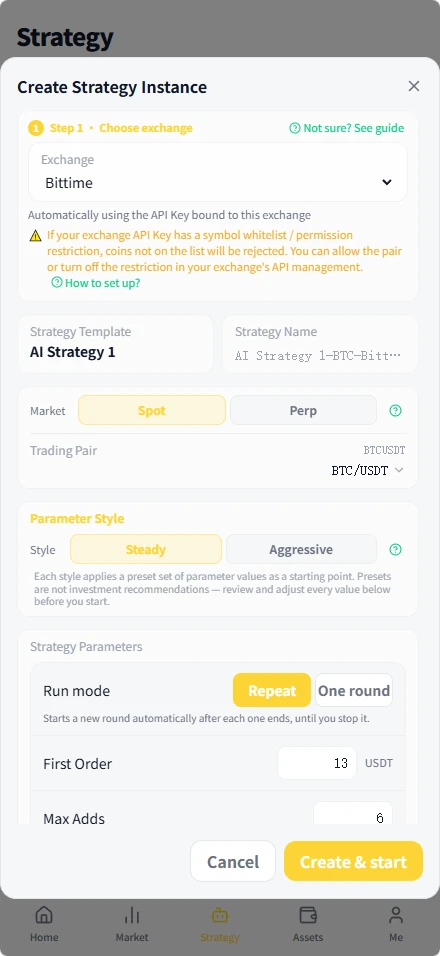
What you set
How many buys, how big the first one is, how much each further one adds, what counts as the target, and the point where you cut it and walk away. All of it is yours. Not one of them is fixed by us.
What you see before you start
How far this money goes — the last buy it can reach under your settings, and how much further price has to fall to use them all up. That number is on the screen before you press start, not after something goes wrong.
What it costs you — you need to know this first
The buys are finite. If price keeps going down and uses them all up, it stops buying, and you are holding a loss you haven't sold — until price comes back to your target, or you decide to walk away. Wanting it to withstand a deeper fall means putting up more money. That is a trade-off, not a setting.
Who it's not for
If you are not willing to put more in while price is falling, this one is not for you.
AI Strategy 2 · Buy a little on dips, sell a little on rises
How it runs
You mark out a price range. Inside it, orders are placed at even spacing, to buy and to sell. As price moves back and forth inside, they fill one step at a time; each step carries its own cost, and is sold once it's ahead.
What you set
The top and bottom of the range, how far apart the steps are, how much money goes in altogether. Yours as well.
What you see before you start
Where the current price sits inside the range you drew. If price is already outside it, you're told plainly what will happen — buy orders sitting there unfilled, or everything bought the moment it starts.
What it costs you — you need to know this first
This one earns from price going back and forth. If price heads down and keeps going, it keeps buying and you hold a pile of losses you haven't sold. If it runs up out of your range, nothing fills any more. A wider range is harder to break out of, but the same money spread thinner earns less on each step.
Who it's not for
A market heading one way and not coming back. Which is exactly what the look before you start is there to warn you about.
Before you press start, it looks first
Whether this coin is going back and forth or heading one way, whether you have enough money, whether each buy clears the exchange's minimum, and whether another strategy on the same account has already claimed that money.
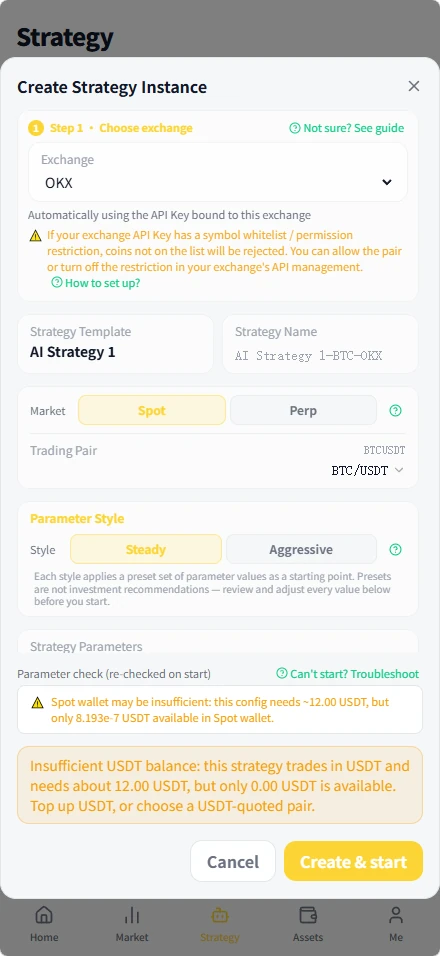
Each item comes back as one of three: good to go, fine but here's something you should know, or this one isn't met and you can't start.
What isn't met has to be sorted out first. The ones that just flag something don't block you — they put the fact in front of you.
You can step in at any time
Every setting is visible and editable. Nothing is hidden. Changes apply right away — no stopping and starting over, and no selling out just to change a number. It sells only when you press stop.
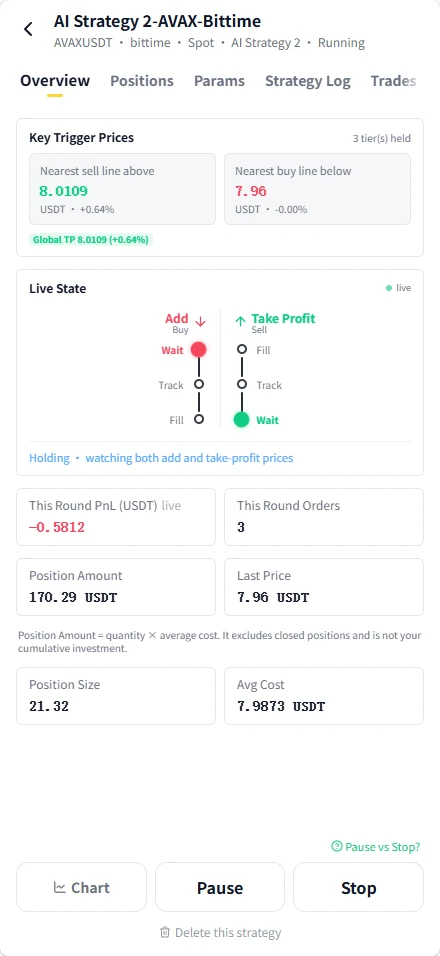
If something goes wrong, you hear it first: it stops and tells you, without touching your position.
We charge only when you make money
On every trade that makes money, we take 20% of it. On a losing one we take nothing, and there is no monthly fee.
Know this first: that 20% is counted on each winning trade on its own. It is not netted against the losing ones. So during a stretch when your account is going down, you can still be charged.
Pick one and let it run
Crypto prices swing hard, and you can lose everything in your exchange account. Letting a system trade for you does not reduce that risk — when the market moves fast, it can lose more. Having made money before doesn't mean it will again. We don't promise you any return, and nobody can. Only use money you can afford to lose. You must be 18 or older.